This is an interesting read from Low End Mac. An excerpt: "The battle is over. The victory won. And the winner is . . . Intel. Macs can now run Windows either as their native operating system (using Boot Camp) or virtualized alongside OS X (Parallels Desktop)." Read more
Low End Mac on Intel and Windows
I Agree...Buy a Mac, Not Vista
A technology writer for Business Week sums it up in this recent article. Everyone would be smart to forgo upgrading to Vista and just break down and buy a new Mac running OS X. It's just the smart thing to do!
Read Stephen H. Wildstrom's column here on the Business Week web site or below.
The Age-Old Question: Mac or PC
Our columnist says that despite the new Windows Vista operating system, if you can afford it, buy a Mac
I'm in the market for a new PC, especially after your recent remarks about upgrading to Vista.
I'm also considering an Apple, primarily because I've read that Apple machines seem not to experience the never-ending attacks from hackers. Is this because of the design of Apple's operating system or because the relatively small number of Apple PCs in the market is not enough to attract attention from hackers?
I'm probably a little above average in tech-savvy, so I'm not afraid to learn a new operating system, even after using Windows forever. I'm a statistical analyst, so I'm primarily interested in technical applications. I also use the Net, but no games, music, or TV. So what's your recommendation, Apple or Vista? I'd appreciate any advice you can offer.
To take your last question first: The coming of Vista does not change my basic recommendation. Unless you have a compelling reason to run Windows or are very constrained by budget (since you can buy a usable PC for less than the cost of the least expensive Mac), the Mac is best choice for consumer.
The question of whether Mac OS X has been relatively free from attacks because it is less popular or because it is less vulnerable is an old and probably irresolvable one. I think the answer is a little of both. These days most attacks on computers are carried out for financial gain, and Windows is by far the more lucrative target.
In terms of raw numbers of vulnerabilities, Windows XP (we don't have any data yet on Vista) and OS X are about the same; the comparison is made a little difficult because Apple, which like Microsoft releases a monthly bundle of security patches, is less specific about what it is fixing. A critical difference, though, is that Windows vulnerabilities have been much easier for the bad guys to exploit successfully.
Architectural changes in Vista and Internet Explorer 7 are supposed to fix that. There's no doubt that the default configurations of both Vista and IE 7 are more secure than their predecessors, but only time will tell how much of a difference this makes in the real world.
Wildstrom is a columnist for BusinessWeek. You can contact him at techandyou@businessweek.com
Apple Profit Rises 27%; Stock Jumps
This is great news for the faithful, as well as anyone desiring to own a world class computer!
By LAURIE J. FLYNN
New York Times
October 19, 2006
SAN FRANCISCO, Oct. 18 — Apple Computer said Wednesday that strong sales of its Macintosh computers and iPod portable music players led to a 27 percent rise in its fiscal fourth-quarter profit.
The results, released after the market closed, caused Apple’s shares to jump as much as 6 percent in late trading as the company surpassed Wall Street forecasts.
Apple said a brisk back-to-school season was a major force behind the better-than-expected results. But executives cautioned that the report was subject to revision, as an investigation into the mishandling of stock option grants was likely to require a restatement of previous results.
The company, which is based in Cupertino, Calif., reported net income of $546 million, or 62 cents a share, in the quarter, up from $430 million, or 50 cents a share, a year earlier. Revenue was $4.84 billion, an increase of nearly 32 percent from $3.68 billion the year before.
Analysts surveyed by Thomson Financial had forecast Apple to report earnings of 51 cents a share on $4.7 billion in revenue.
Macintosh sales accounted for 58 percent of revenue in the quarter, spurred in part by the new school season’s huge demand for notebook computers, the company said. In September, Apple expanded its line of Macs and completed a transition to Intel-based microprocessors.
In a conference call with analysts, the chief financial officer, Peter Oppenheimer, spoke of “the best Mac shipments by far in any quarter in Apple’s history.”
Steve Jobs' Stanford Commencement Speech
 Thank you. I'm honored to be with you today for your commencement from one of the finest universities in the world. Truth be told, I never graduated from college and this is the closest I've ever gotten to a college graduation.
Today I want to tell you three stories from my life. That's it. No big deal. Just three stories. The first story is about connecting the dots.
I dropped out of Reed College after the first six months but then stayed around as a drop-in for another eighteen months or so before I really quit. So why did I drop out? It started before I was born. My biological mother was a young, unwed graduate student, and she decided to put me up for adoption. She felt very strongly that I should be adopted by college graduates, so everything was all set for me to be adopted at birth by a lawyer and his wife, except that when I popped out, they decided at the last minute that they really wanted a girl. So my parents, who were on a waiting list, got a call in the middle of the night asking, "We've got an unexpected baby boy. Do you want him?" They said, "Of course." My biological mother found out later that my mother had never graduated from college and that my father had never graduated from high school. She refused to sign the final adoption papers. She only relented a few months later when my parents promised that I would go to college.
This was the start in my life. And seventeen years later, I did go to college, but I naïvely chose a college that was almost as expensive as Stanford, and all of my working-class parents' savings were being spent on my college tuition. After six months, I couldn't see the value in it. I had no idea what I wanted to do with my life, and no idea of how college was going to help me figure it out, and here I was, spending all the money my parents had saved their entire life. So I decided to drop out and trust that it would all work out OK. It was pretty scary at the time, but looking back, it was one of the best decisions I ever made. The minute I dropped out, I could stop taking the required classes that didn't interest me and begin dropping in on the ones that looked far more interesting.
It wasn't all romantic. I didn't have a dorm room, so I slept on the floor in friends' rooms. I returned Coke bottles for the five-cent deposits to buy food with, and I would walk the seven miles across town every Sunday night to get one good meal a week at the Hare Krishna temple. I loved it. And much of what I stumbled into by following my curiosity and intuition turned out to be priceless later on. Let me give you one example.
Reed College at that time offered perhaps the best calligraphy instruction in the country. Throughout the campus every poster, every label on every drawer was beautifully hand-calligraphed. Because I had dropped out and didn't have to take the normal classes, I decided to take a calligraphy class to learn how to do this. I learned about serif and sans-serif typefaces, about varying the amount of space between different letter combinations, about what makes great typography great. It was beautiful, historical, artistically subtle in a way that science can't capture, and I found it fascinating.
None of this had even a hope of any practical application in my life. But ten years later when we were designing the first Macintosh computer, it all came back to me, and we designed it all into the Mac. It was the first computer with beautiful typography. If I had never dropped in on that single course in college, the Mac would have never had multiple typefaces or proportionally spaced fonts, and since Windows just copied the Mac, it's likely that no personal computer would have them.
If I had never dropped out, I would have never dropped in on that calligraphy class and personals computers might not have the wonderful typography that they do.
Of course it was impossible to connect the dots looking forward when I was in college, but it was very, very clear looking backwards 10 years later. Again, you can't connect the dots looking forward. You can only connect them looking backwards, so you have to trust that the dots will somehow connect in your future. You have to trust in something--your gut, destiny, life, karma, whatever--because believing that the dots will connect down the road will give you the confidence to follow your heart, even when it leads you off the well- worn path, and that will make all the difference.
My second story is about love and loss. I was lucky. I found what I loved to do early in life. Woz and I started Apple in my parents' garage when I was twenty. We worked hard and in ten years, Apple had grown from just the two of us in a garage into a $2 billion company with over 4,000 employees. We'd just released our finest creation, the Macintosh, a year earlier, and I'd just turned thirty, and then I got fired. How can you get fired from a company you started? Well, as Apple grew, we hired someone who I thought was very talented to run the company with me, and for the first year or so, things went well. But then our visions of the future began to diverge, and eventually we had a falling out. When we did, our board of directors sided with him, and so at thirty, I was out, and very publicly out. What had been the focus of my entire adult life was gone, and it was devastating. I really didn't know what to do for a few months. I felt that I had let the previous generation of entrepreneurs down, that I had dropped the baton as it was being passed to me. I met with David Packard and Bob Noyce and tried to apologize for screwing up so badly. I was a very public failure and I even thought about running away from the Valley. But something slowly began to dawn on me. I still loved what I did. The turn of events at Apple had not changed that one bit. I'd been rejected but I was still in love. And so I decided to start over.
I didn't see it then, but it turned out that getting fired from Apple was the best thing that could have ever happened to me. The heaviness of being successful was replaced by the lightness of being a beginner again, less sure about everything. It freed me to enter one of the most creative periods in my life. During the next five years I started a company named NeXT, another company named Pixar and fell in love with an amazing woman who would become my wife. Pixar went on to create the world's first computer-animated feature film, "Toy Story," and is now the most successful animation studio in the world.
In a remarkable turn of events, Apple bought NeXT and I returned to Apple and the technology we developed at NeXT is at the heart of Apple's current renaissance, and Lorene and I have a wonderful family together.
I'm pretty sure none of this would have happened if I hadn't been fired from Apple. It was awful-tasting medicine but I guess the patient needed it. Sometimes life's going to hit you in the head with a brick. Don't lose faith. I'm convinced that the only thing that kept me going was that I loved what I did. You've got to find what you love, and that is as true for work as it is for your lovers. Your work is going to fill a large part of your life, and the only way to be truly satisfied is to do what you believe is great work, and the only way to do great work is to love what you do. If you haven't found it yet, keep looking, and don't settle. As with all matters of the heart, you'll know when you find it, and like any great relationship it just gets better and better as the years roll on. So keep looking. Don't settle.
My third story is about death. When I was 17 I read a quote that went something like "If you live each day as if it was your last, someday you'll most certainly be right." It made an impression on me, and since then, for the past 33 years, I have looked in the mirror every morning and asked myself, "If today were the last day of my life, would I want to do what I am about to do today?" And whenever the answer has been "no" for too many days in a row, I know I need to change something. Remembering that I'll be dead soon is the most important thing I've ever encountered to help me make the big choices in life, because almost everything--all external expectations, all pride, all fear of embarrassment or failure--these things just fall away in the face of death, leaving only what is truly important. Remembering that you are going to die is the best way I know to avoid the trap of thinking you have something to lose. You are already naked. There is no reason not to follow your heart.
About a year ago, I was diagnosed with cancer. I had a scan at 7:30 in the morning and it clearly showed a tumor on my pancreas. I didn't even know what a pancreas was. The doctors told me this was almost certainly a type of cancer that is incurable, and that I should expect to live no longer than three to six months. My doctor advised me to go home and get my affairs in order, which is doctors' code for "prepare to die." It means to try and tell your kids everything you thought you'd have the next ten years to tell them, in just a few months. It means to make sure that everything is buttoned up so that it will be as easy as possible for your family. It means to say your goodbyes.
I lived with that diagnosis all day. Later that evening I had a biopsy where they stuck an endoscope down my throat, through my stomach into my intestines, put a needle into my pancreas and got a few cells from the tumor. I was sedated but my wife, who was there, told me that when they viewed the cells under a microscope, the doctor started crying, because it turned out to be a very rare form of pancreatic cancer that is curable with surgery. I had the surgery and, thankfully, I am fine now.
This was the closest I've been to facing death, and I hope it's the closest I get for a few more decades. Having lived through it, I can now say this to you with a bit more certainty than when death was a useful but purely intellectual concept. No one wants to die, even people who want to go to Heaven don't want to die to get there, and yet, death is the destination we all share. No one has ever escaped it. And that is as it should be, because death is very likely the single best invention of life. It's life's change agent; it clears out the old to make way for the new. right now, the new is you. But someday, not too long from now, you will gradually become the old and be cleared away. Sorry to be so dramatic, but it's quite true. Your time is limited, so don't waste it living someone else's life. Don't be trapped by dogma, which is living with the results of other people's thinking. Don't let the noise of others' opinions drown out your own inner voice, heart and intuition. They somehow already know what you truly want to become. Everything else is secondary.
When I was young, there was an amazing publication called The Whole Earth Catalogue, which was one of the bibles of my generation. It was created by a fellow named Stewart Brand not far from here in Menlo Park, and he brought it to life with his poetic touch. This was in the late Sixties, before personal computers and desktop publishing, so it was all made with typewriters, scissors, and Polaroid cameras. it was sort of like Google in paperback form thirty-five years before Google came along. I was idealistic, overflowing with neat tools and great notions. Stewart and his team put out several issues of the The Whole Earth Catalogue, and then when it had run its course, they put out a final issue. It was the mid-Seventies and I was your age. On the back cover of their final issue was a photograph of an early morning country road, the kind you might find yourself hitchhiking on if you were so adventurous. Beneath were the words, "Stay hungry, stay foolish." It was their farewell message as they signed off. "Stay hungry, stay foolish." And I have always wished that for myself, and now, as you graduate to begin anew, I wish that for you. Stay hungry, stay foolish.
Thank you all, very much.
Watch the video on YouTube:
Bill Gates is One Rich Guy
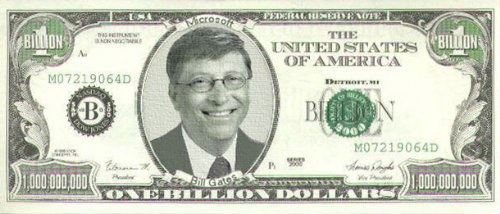 Some time ago I ran across this interesting article by Brad Templeton about Microsoft founder Bill Gates. Brad states that since Microsoft's founding in 1975, Gates has made about $300 a second during a 14-hour work day. That's a lot of dough, for sure.
The article also includes links to charts, Bill Gates Net Worth Page and Bill Gates Personal Weath Clock. It's definitely worth a look. Brad has done his homework! Check it out here.
Prediction: OS X Available for PC in 2006
Robert X. Cringely, author of the PBC.com column, "I, Cringely," predicts Apple will succumb to market pressure and make Mac OS X available - though unsupported - on PC hardware. I agree, however I think it will happen within the next two years, not in 2006. Time will tell. Following is the prediction:
"But Apple WILL make some inroads against Microsoft. The new Intel Macs will run Windows XP unofficially, and Apple Support acknowledges that they are only days from running XP officially, too. So Apple finally has a solid argument why Windows-centric companies and homes should consider trying a Mac. The best case, though, says that Apple sells an additional million units, which aren't enough for Steve Jobs, so I see him going into a kind of stealth competition with Microsoft.
"Here's how I believe it will work. Apple won't offer versions of OS X for generic Intel hardware because the drivers and the support obligation would be too huge. But just as you can buy a shrink-wrapped copy of 10.4 for your iMac, they'll gladly sell you a shrink-wrapped Intel version intended for an Intel Mac, but of course YOU CAN PUT IT ON ANY MACHINE YOU LIKE. The key here is to offer no guarantees and only limited support, patterned on the kind you get for most Open Source packages -- a web site, forums, download section. and a wiki. Apple will help users help themselves. With two to three engineers and some outreach to hackers and hardware makers, Apple could put together an unofficial program that could easily attract two to three million Windows users per year to migrate their old machines to the new OS. Imagine the profit margins of three engineers effectively generating $300-plus million per year in sales."
Jobs Returns to Apple (from 1996 article)
As we begin 2006, I found this little tidbit from Reuters while looking through some old files. Steve Jobs returned triumphantly to Apple in December 1996, shocking the tech industry. The rest, as they say, is history. You'll note at the bottom this article was downloaded from CompuServe. Remember that? :-)
Apple Brings Steve Jobs Home
(Dec. 21) Stunning the computer industry, Apple Computer Inc. has agreed to acquire NeXT Software Inc. for $400 million, reuniting Apple with its co-founder, Steve Jobs.
"The acquisition," says Kourosh Karimkhany of the Reuter News Service, "will give Apple the software technology it needs to revamp the Macintosh personal computer, which has lost much of its technological luster to PCs running software from Microsoft Corp."
At Apple's Cupertino, California, headquarters, Jobs told the wire service, "The Mac has provided the innovation that the industry has been feeding off for the last 10 years. It's time for someone to come up with innovation to drive the industry forward. Who better than Appl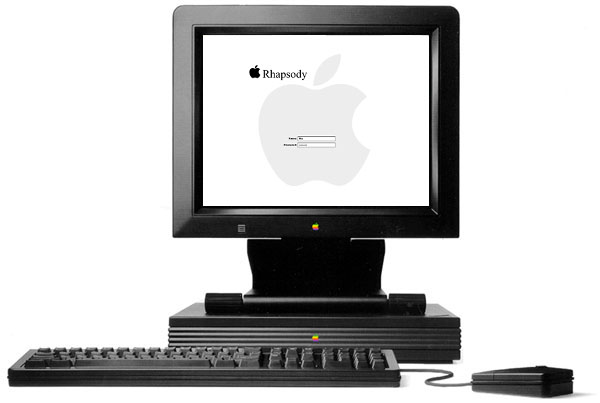 e?"
e?"
Jobs, who founded Apple with Steve Wozniak in his garage 20 years ago, led Apple through its early years until he was fired by the company's board in 1985.
Apple now will pay $350 million, mostly in cash and a little stock, for Redwood City, California, NeXT, and will pay off NeXT's $50 million debt.
Jobs will come back to Apple part-time to lead an effort to rewrite the fundamental software of the Macintosh, reporting to Apple Chairman Gilbert Amelio.
Apple will base much of its next-generation operating system on Nextstep, Karimkhany reports, quoting Amelio as saying NeXT's technology will not only provide many of the software bells and whistles that Apple needs to compete with Microsoft's Windows, but will attract outside software companies to write more titles for the Mac.
"Without question, the technology at NeXT was the superior technology, by a significant amount," Amelio said.
As reported, Apple had been for months looking outside for help after having abandoned an unfinished operating system code-named "Copland." The company looked at operating system technology and multimedia software from companies such as Sun Microsystems Inc. and closely held Be Inc.
Jobs also helped co-found Pixar Animation Studios, a production studio that uses powerful computers instead of drawings. The company made last year's hit "Toy Story." He told Reuters he will continue to run Pixar.
Reports from Reuter News Service are a regular feature of CompuServe's Executive News Service (GO ENS).
--Charles Bowen
Apple Site Grows Faster than Google
As it turns out, Apple is more popular than everyone's favorite search engine Google - at least in November. The Associated Press reported yesterday the popularity of the iPod and iTunes has resulted in explosive growth for Apple's web site. Amazing. Below is the article:
Apple's Web Site Among Fastest Growing
Thu Dec 22, 8:07 AM ET (AP) - Driven largely by the popularity of the iTunes music service and software, Apple Computer Inc.'s Web site was the fastest growing last month among the major brands, according to a study by Nielsen/NetRatings.
The site drew 30.8 million unique visitors in November, a 57 percent jump from the 19.6 million a year earlier. Google Inc. saw a 29 percent growth in visitors while Amazon.com Inc. had a 16 percent boost.
Yahoo Inc. (Nasdaq:YHOO - news) remained the Web's leading brand with 104 million visitors, a 10 percent increase from November 2004. But among the Web's top 10 brands, Yahoo's growth ranked only seventh.
Comparing all sites with at least 1 million visitors in November, the PhotoBucket photo-sharing site saw the largest growth — a 16-fold increase to 15.6 million visitors, from 983,000 last year.
Social networking sites MySpace and Facebook had the second- and third-highest growth, respectively. Wikipedia, an encyclopedia that lets volunteers add and change entries regardless of their expertise, was ninth on the list, nearly quadrupling its traffic.
Copyright © 2005 The Associated Press.
Mossberg is Convert to the Mac Way
Without a doubt, Walk Mossberg of the Wall Street Journal has been transformed into a Mac fan the past couple of years. While Mossberg once spoke of Macs with sarcasm and disdain, he now praises Apple for the beautiful machines and operating system Mac devotees have loved for two decades.
Mossberg's latest column praises the iMac G5 as the "gold standard" of personal computers. Way to go, Walt! Read the entire article.
TiVo Digital Downloads Could Transform TV
An announcement by the makers of TiVo to make TV shows downloadable to digital devices has the potential to revolutionize TV as we know it. Apple with the video-capable iPod and other manufacturers are making possible TV-to-go for the masses, the big question now is easy-to-obtain and free content. TiVo's plan will make this a reality. I wonder now how TiVo is going to get around content-provider concerns that users will pirate material. Time will tell. Read the article in MacWorld.
The Mark Away from Windows
Business Week has published an interesting report about the move away from Windows to the Macintosh platform among some computer users.
Fueling the growth in "switchers" is the popularity of the iPod and Mac operating system's advanced security against viruses and spyware.
"Wolf has created an interesting forecast model in which he assumes that 11% of Windows users who buy iPods also purchase Macs at the same time or soon afterward. The model also assumes that of these new Mac buyers most stick to the Mac platform and buy a second one when it comes time to upgrade."
Read the entire article here.Is iPod's Popularity Waning?
According to The Financial Express, Apple Computer’s continued dominance of the MP3 market is prompting more people to examine exactly what it is that makes the iPod so successful.
Many attribute the iPod’s dominance to Apple’s coolness, but according to the report, "Understanding iPod’s Dominance: A Consumer Perspective," Apple’s coolness appears to be waning. The reasons most often cited for purchasing an iPod have more to do with brand familiarity than Apple’s cachet.
Today’s iPod buyer is driven by practical considerations more than social status, according to Dale Gilliam III, director of primary research at the Diffusion Group, a media research and consulting company. Coolness ranked third among people aged 15 to 24, behind quality of interface and familiarity with the brand. Design aesthetics and quality of interface were the top two reasons cited by the 25- 34-year-old age group for purchasing an iPod. Among those between 35 and 50, familiarity with Apple and the iPod brand were the primary reasons they chose the iPod.
Video iPod May Change TV
Apple may have stumbled onto something very great, and it's called iTV.
The new iPod that supports video could very well change TV and video the way the original iPod changed eletronic music. Only time will tell.
Admitedly, there's still a lot of shaking out yet to be done. It may be months or years before we see clearly the impact the video-enabled iPod makes. Some, like Business Week have seen the future and it's huge.
OS X Continues to Impress
A few weeks ago I rescued our old clamshell "Black Tie" iBook that had found a home in my daughter's closet.
The iBook was stored after the CD/DVD door had stuck open. After a few days tinkering with it, I got the door to close and it was whole once again. Apparently, my daughter had accidentially pulled the door out too far.
Satisfied of my handyman abilities, I began using the machine and was impressed how strong its Airport reception and battery life was compared to my 12-inch G4 PowerBook. What I wasn't happy with was the 9.0.4 operating system it was running. I continued to use the iBook and began to experience daily system crashes and reboots. Then I read an article on O'Grady's PowerPage about his installation of OS X on a Blueberry iBook. Up until then I never thought about installing OS X on the iBook, figuring it would run way too slow.
Well, to make a long story a bit shorter, O'Grady installed Tiger on his aging iBook, breathing life into the once fanciful iBook. I decided to try it too.
After updating OS 9 to 9.2.2, I went for the gold, installing OS 10.2.8 (I don't own Tiger). The installation when extremely well, and despite the limited 800 x 600 screen real estate, I have enjoyed every minute of the iBook since. What I have especially enjoyed is that it hasn't crashed once since the installation.
While not a screamer, the machine handles OS X better than I ever expected. What's more, I get to use the same updated OS X apps that my other Macs use, such as Word.
Apple did a good thing when it finally updated its aging OS 9 system with OS X. With the move to Intel chips, I figure more of the world will discover this world class operating system really soon.
Oh, That Windows Feeling!
About four years ago my mother decided she wanted to buy a new computer and asked me what I would recommend.
Since she lives in a rural area of Missouri - though I really wanted to recommend a Mac - I decided to help her with the purchase of a Dell (www.dell.com) running Windows XP. At the time she bought the machine she also purchased Dell's extended warranty which provided telephone technical assistance and on site computer repair. I also made certain she bought virus software after the 90-day free trial version expired.
For the first year or so, all went fairly well with my Mom's Dell. Since e-mail, light Internet browsing, and an occasional game of Solitaire was all she used the computer for, XP worked for her.
Then it happened. Despite my warnings, she accidentially downloaded and opened an attachment that contained a virus. The computer ended up having to be taken to the local computer repair shop where technicians were happy to clear the machine up and charge my mother handsomely for their services (which was about a 15 percent of the original purchase price of the computer).
More time passed. Last week, Mom told me she was unplugging her computer for a few days while the current Windows virus threat blew over. I told her that unplugging the computer wouldn't keep the computer from getting the virus, as the machine could only be infected when she was connected to the Internet (she's on a slow dial-up connection).
Finally, I told Mom she might want to consider buying a Mac. She agreed but said she really doesn't have the money to do that right now.
The moral of the story is that I should have recommended a Mac from the beginning of my mother's computer experience. I thought at the time that her limited use of a PC running Windows would work okay, but I was sorely wrong.
You live and learn. She definitely is experiencing "that Windows feeling."
Apple to be Intel's "Show Pony?"
Rhonda Ascierto of the Computer Business Review reports about the newfound lovefest between Apple and Intel in the article, "Apple may be Intel show pony." Ascierto quotes IDC analyst Roger Kay: "Apple could be become the showcase for Intel's technology." I think Kay is on to something.
Apple already has practically cornered the digital music market by "getting it right." But another frontier is on the horizon: digital video...and no one has gotten it right yet either. If Apple - powered by Intel technology - were do for digital video what it has done for digital music, a new giant in the entertainment business could be born.
Now Steve Jobs has said more than once that watching video on the tiny screen of an iPod is not the experience people want. But what if Apple produced a device that's as small as an iPod with the capability of a consumer "digital hub?" Want to listen to music? Use the device as a stand alone player or feed it through your home stereo system. Want to watch the latest release of a new movie? Just hook the device up to your home TV system. If you're on the go, just watch the movie on the built-in screen or project it on the wall. A true portable digital device for all occasions!
Intel technology is closer to making this happen than IBM or Motorola and Apple saw the writing on the wall. If you think about it, it's amazing it took Apple this long to make the switch. In 1998 I talked about the promising future of the PowerPC chip in the article, "The Second Coming the of Macintosh." There's some great technology in the PowerPC chipset, but when it comes to portability and power consumption, Intel has leaped ahead big time.
The bottom line is Apple had little choice to do what it did. It will be exciting to see what the most innovative computer and software maker in the world will do with this opportunity in years to come. There will be bumps along this conversion, but with Apple encouraging developers to produce both PowerPC and Intel versions of their apps for the foreseeable future, there should be little compatibility concerns for current and future Mac users.
Tim Yarbrough
MacDoor Editor
Apple Better Off with "Intel Inside"
Well, it's true. Apple is moving to Intel. Who would have ever imagined it? Actually, the move to Intel technology makes a lot of sense for Apple, which since the introduction of OS X has moved its core architecture to previously PC-only territory. It will be interesting to see how the "establishment PC" crowd will feel about Apple now.
Few argue that Apple has one of the most stable and robust operating systems out there today. Windows still rules the day, of course, but OS X with its rock-solid stability and immunity to many viruses has got it noticed outside creative and scientific circles in recent years.
What's still missing is OS X's robustness in the enterprise. Windows has such a head start, one wonders if Apple could ever catch up. But again, who would have foreseen the Mac GUI running on top of UNIX powered by Intel chips?
Moving to Intel means Apple will finally produce a world class laptop with world class power-saving features and extended battery life. My G4 Powerbook running OS X is a great machine, but it's no match for my office HP laptop with its P4M. Battery life on the PC extends easily to 4 or 5 hours, while the Powerbook stuggles to run 2 to 3 hours...especially when pushed by intense computing.
Scalability is another factor I'm certain Steve Jobs considered in deciding to switch. It is very possible you could see OS X running on your iPod, cell phone or PDA in the very near future.
Long gone are the days of Apple's legendary hardware/software integration. It just isn't as necessary today as it was in the early days of computing.
Will Apple's move to Intel mean we can buy any piece of hardware off the shelf to run OS X? I doubt that is Jobs' intention, but I figure if he tries to prohibit it someone will reverse engineer around it and make it possible.
I continue to be very optimistic about Apple's future. I figure the move to Intel will be the last straw for some of the Apple faithful, but those losses will be easily replaced by appealing to a new and larger market that never would have considered an Apple without "Intel Inside."
Tim Yarbrough
MacDoor Editor
Apple Moving to Intel: Say It Ain't So!
CNet's report yesterday that Apple is ready is switch to Intel chips is interesting, to say the least. What this move - if true - would mean to the loyal Apple fan base is unclear. After all, the Macintosh experience has always been about the user interface, not the chip that powers the screen. However, the anti-Big Brother mentality Steve Jobs has fostered at the company for years has meant Apple usually looked for non-PC alternatives which meant for years using Motorla chips and since the mid-1990s, chips powered by IBM technology.
Personally, I think it would give Apple a big advantage to use the chip set "the rest of the world uses," which potentially will result in lower computer hardware prices and increased compatibility.
Time will tell. I can't wait to see if the news is true.
Tim Yarbrough
MacDoor Editor
So What's the 'Next Big Thing' for Apple?
By Tim Yarbrough
MacDoor Editor
zxmac8384@yahoo.com
The 2004 Christmas shopping season will be known as the "Year of the iPod" just as in past years were known for the Cabbage Patch doll and Tickle Me Elmo.
What's different is the iPod is a utility device that will bring millions of users years of music enjoyment and a reason to access Apple's iTunes store to buy new music.
IBM Helps Promote Linux
By Steve Lohr
Linux is a rising star in the geeky back office of computing. Its gains have come as an operating system for the data-serving computers that run corporate networks and serve up Web pages. On the desktop, Microsoft's Windows still reigns supreme.
But I.B.M. and the Open Source Development Lab, whose membership includes Hewlett-Packard, Dell and Intel, are beginning a drive to promote Linux as an alternative to Windows on the desktop.
One indication of their more aggressive approach came yesterday when an I.B.M. executive, Samuel J. Docknevich, delivered a speech at a technology conference outside Boston titled "The Time Is Now for Linux on the Desktop."
The Open Source Development Lab - a nonprofit organization to advance the use of open source software like Linux - is planning a program to encourage corporate adoption of desktop Linux, set to begin in January. "We're going to push a big desktop Linux initiative," Stuart F. Cohen, chief executive of the Open Source Lab, said last week in an interview. "It's clearly something our members want."
Mr. Cohen and others at the organization gave few details, except to say that the lab would try to broaden the base of support for desktop Linux. That, for example, might include helping with technology that could make it easier for Linux users to exchange data and documents created with Windows-based software. It might also include persuading the makers of popular personal computer software, like RealNetworks' media player or Adobe's desktop publishing software, to create Linux versions.
Any inroads Linux makes on the desktop will probably come slowly. More than 300 million people worldwide use the Windows desktop operating system and Microsoft's Office suite, which includes the Word, Excel and PowerPoint programs.
But Linux advocates say that the full complement of Microsoft desktop software has far more features, and is far more costly, than most workers at many companies really need.
And corporate technology officers are concerned about the cost of upgrading tens of thousands of PC's every couple of years to new versions of Microsoft software and about the security flaws in Microsoft products that have been exploited regularly by digital vandals writing viruses and worms.
Linux has gained desktop converts for specialized uses like software development, computer animation and in scientific computing. Abroad, some governments and municipalities have championed the use of Linux. Earlier this year, for example, Munich announced that it would move from Windows to Linux on 14,000 desktop machines used by city workers.
Yet Linux on the desktop has not really made its way into the mainstream corporate market, especially in the United States. And I.B.M., whose entry into the personal computer business in 1981 made the PC a respected business tool, has the influence with corporate customers to give Linux on the desktop real credibility, analysts say.
"There is a lot of interest in Linux on the desktop from customers; this is definitely a trend with traction," said Scott Handy, vice president for Linux strategy and market development at I.B.M. "But we're being very pragmatic."
Long gone are the days of OS/2, I.B.M.'s desktop operating system, when Big Blue tried to confront Windows head on and wrest dominance of the operating system market from Microsoft.
The I.B.M. plan now is to use Linux as the desktop operating system in a simplified computing environment that relies on delivering, updating and maintaining desktop applications over high-speed corporate networks. Faster, low-cost telecommunications and improved Internet software make the transition possible, Mr. Handy said.
Studies have estimated the total cost of ownership of a PC in a corporate setting at $5,000 to $7,000 a year. The hardware and software costs are typically less than 30 percent of the total, with the expense of maintaining, updating and debugging accounting for the rest.
Deploying Linux and having applications centrally distributed and managed on server computers, using Internet technology, can cut the cost of owning a desktop machine in half or more, Mr. Handy said.
"The discussion with customers usually starts with Linux," he said. "But the huge gains come from using this server-based architecture, which is made possible by these Internet technologies. And Linux is one of them."
I.B.M., Mr. Handy said, is conducting dozens of assessments for corporate customers of Linux desktop use as part of a program to reduce costs. The companies, he said, do not want to be named because they have not decided to switch desktop technologies.
The Linux desktops tap into the applications on server computers, using a browser. E-mail, calendar, customer relationship management and word-processing applications are included. Mr. Handy said this kind of computing could be easily adopted by bank branch offices, sales people, insurance agents, auto dealers and others.
I.B.M. is trying it itself. About 15,000 workers use Linux desktops, mostly software developers and researchers. By the end of the first quarter of next year, I.B.M. plans to increase the number of Linux desktops to 30,000 as sales, marketing and administrative workers try it.
Still, Linux on the desktop has a long way to go. Shipments of Linux rose to 2.8 percent of desktop operating systems in 2002, up steadily from 1.7 percent two years earlier, according to IDC, a research firm. Windows accounted for nearly 94 percent of shipments last year.
Subscribe to:
Posts (Atom)